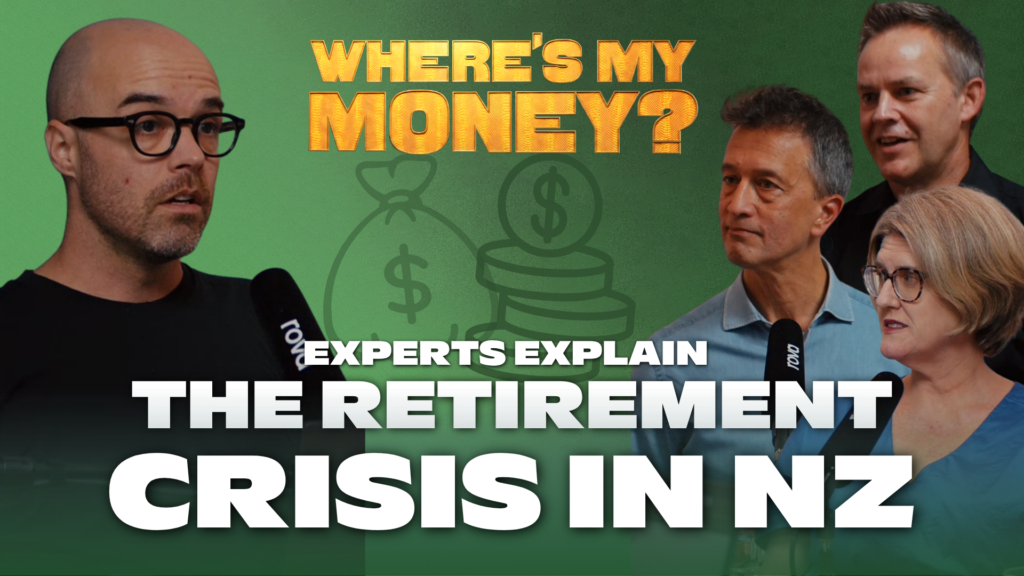
Where’s My Money? Season 7, Episode 6
Retirement can feel like one of those financial jobs that belongs firmly in the “I’ll worry about that later” category.
After all, there are mortgages to pay, children to raise, holidays to save for and plenty of other financial priorities competing for our attention today.
But what happens when “later” arrives?
This episode of Where’s My Money? takes a closer look at why so many Kiwis lack confidence about retirement – and why waiting until you’re 50, 60 or even closer to finishing work could mean missing some of your biggest opportunities to shape what comes next.
Reagan White is joined by Karla Byrnes from AMP, Tom Hartmann from Sorted and Dave Martin from Summerset Retirement Villages for a wide-ranging conversation about retirement confidence, KiwiSaver, home ownership, investing, longevity and, perhaps most importantly, what we actually want our lives to look like when work is no longer the centre of them.
Only 45% of Kiwis feel confident about retirement
The conversation starts with a pretty confronting statistic: only 45% of Kiwis feel confident about their retirement.*
That’s fewer than one in two people feeling genuinely confident about what’s ahead.
Karla explains that there are plenty of reasons for that uncertainty, from the rising cost of living and what’s happening in global markets to uncertainty about the future of the retirement system itself.
But there’s another problem: many of us simply don’t know what we’re planning for.
And that uncertainty can make it tempting to put retirement planning off altogether.
Mistake #1: Waiting until you’re “old enough” to think about retirement
One of the biggest themes throughout the episode is that retirement isn’t an event you suddenly need to start preparing for when you hit 50.
In fact, by then, you may have already missed decades of opportunities for your money to grow.
Tom Hartmann explains that people in their younger years have the greatest amount of time on their side – even if retirement feels impossibly far away.
KiwiSaver is a perfect example.
The money being contributed when you’re in your teens, 20s and 30s might not feel particularly significant at the time. But decades of contributions and investment growth can make a substantial difference to your future financial position.
The key is getting started – and making sure you understand what you’re actually investing in.
Mistake #2: Treating KiwiSaver like a savings account
The name doesn’t necessarily help.
“KiwiSaver” can sound like a straightforward savings account, but the episode makes an important distinction: KiwiSaver is an investment scheme.
Reagan puts it bluntly: “But it is not savings, it is an investment scheme.”
That means it’s worth understanding who your provider is, what fund you’re invested in and whether that approach is appropriate for your circumstances and timeframe.
The research discussed in the episode found that around 20% of people surveyed didn’t even know who had their KiwiSaver.
That’s a pretty good reason to check.
It isn’t necessarily about constantly changing funds or trying to pick the next winning investment. It’s about knowing where your money is, understanding how it’s invested and making sure you’ve made an informed decision.
As Karla says: “We need to be educating from not just at 50, 60. We need to be educating from 18 … you know, 16.”
Book a KiwiSaver Review
Mistake #3: Assuming your house is your retirement plan
For generations of New Zealanders, owning a home has been seen as the ultimate financial safety net.
And owning your home outright can certainly provide security and reduce your living costs in retirement.
But there’s a difference between having wealth and having wealth you can actually use to fund your lifestyle.
Dave explains that many retirees reach retirement believing their home will solve their financial problems, only to discover that much of their wealth is tied up in the property.
“I think a lot of New Zealanders rely on their house. That’s their savings plan.”
The challenge is that the equity in your home isn’t necessarily available to spend without making a significant decision about the property itself.
That doesn’t mean owning a home isn’t valuable. It means it shouldn’t necessarily be the only part of your long-term financial plan.
As Reagan points out, KiwiSaver alone may not be enough either.
“You need to have some kind of other assets or investments to realise and, turn your retirement into what you want it to be.”
The takeaway isn’t that everyone needs to become an investor or build a huge portfolio.
It’s that retirement planning works best when you understand where your future income is actually going to come from.
Mistake #4: Thinking retirement means stopping work completely
Perhaps one of the most interesting parts of the conversation is the challenge to the word “retirement” itself.
For many people, retirement conjures up a very traditional image: finish work, stop earning, move into a retirement village and slow down.
But that’s increasingly not how life looks.
People are living longer. Careers are changing. Some people continue working part-time, change careers, start businesses or simply choose to work differently.
Dave makes an important point: instead of starting the conversation with “How much money will I need to retire?”, perhaps we should start somewhere else.
That’s a much more motivating question.
Do you want to travel? Spend more time with family? Live near the beach? Work three days a week? Start a business? Volunteer? Move overseas? Stay exactly where you are?
Once you have a picture of the life you want, you can start working backwards to understand what your finances need to look like to support it.
Mistake #5: Thinking 50 is the magic age to start planning
The 40s and 50s can be a financial turning point.
You may be earning more than you ever have before, but you might also have significant commitments – mortgages, children, education costs and other expenses.
The temptation is to think, I’ll sort retirement once the kids are gone or I’ll get serious about it when I’m 50.
But the episode suggests that there isn’t really a magic age.
Karla describes thinking about retirement as early as her 20s and 30s, while acknowledging that everyone’s circumstances are different.
The reality is that people are reaching retirement at very different stages of life. Some are still paying off mortgages in their 60s. Others are supporting children well into adulthood.
We’re also living longer than previous generations.
Karla points out that while previous generations might have planned for five or ten years of retirement, people today may need to fund 25 years or more.
That changes the maths considerably.
Retirement isn’t just about money – it’s about freedom
Perhaps the biggest takeaway from the episode is that retirement planning shouldn’t be about reaching an arbitrary dollar figure and hoping it’s enough.
It’s about creating choices.
As Reagan reflects when talking about his own grandfather, retirement looked completely different from the traditional picture. He moved north, lived near the beach, fished and spent his later years doing things he loved.
It was his version of retirement.
And that’s really the point. Everyone’s retirement looks different. There is no single version of a good retirement.
The important thing is to start thinking about what yours might look like – and then make financial decisions that give you the best chance of making it happen.
The biggest retirement regret? Not starting the conversation earlier
There’s perhaps no better reason to start thinking about this now than the experience of people who have already reached retirement.
Reagan shares that 62% of retirees wish they had started preparing earlier.*
When asked what the biggest regret is among the retirees he works with, Tom says:
And importantly, that doesn’t necessarily mean talking about investment returns, KiwiSaver balances or retirement income.
It’s about talking about life.
That’s something we can all start doing.
You don’t need to know exactly when you’ll retire. You don’t need to know exactly how much you’ll need. And you don’t need to have everything figured out today.
But starting the conversation gives you more time to understand your options, make changes and build a financial plan around the life you actually want.
Start planning the life you want
Retirement might seem a long way away.
That’s exactly why now is such a powerful time to think about it.
The earlier you start, the more time you have to build good habits, make informed decisions about KiwiSaver and other investments, understand your future income and adjust your plan as your life changes.
You don’t need to have all the answers. You just need to start asking the questions.
Prepare for Retirement With Confidence.
Watch the full episode of Where’s My Money? below:
Disclaimer: The Where’s My Money? podcast and the information shared by host Reagan White and his guests does not constitute individual financial advice. If you’re interested in receiving financial advice, you can book a consultation with an enable.me financial coach. Costs apply.
*Source: AMP Retirement Confidence Pulse, April 2026